Mustang!
First published as a cover story by Smithsonian magazine in 1997

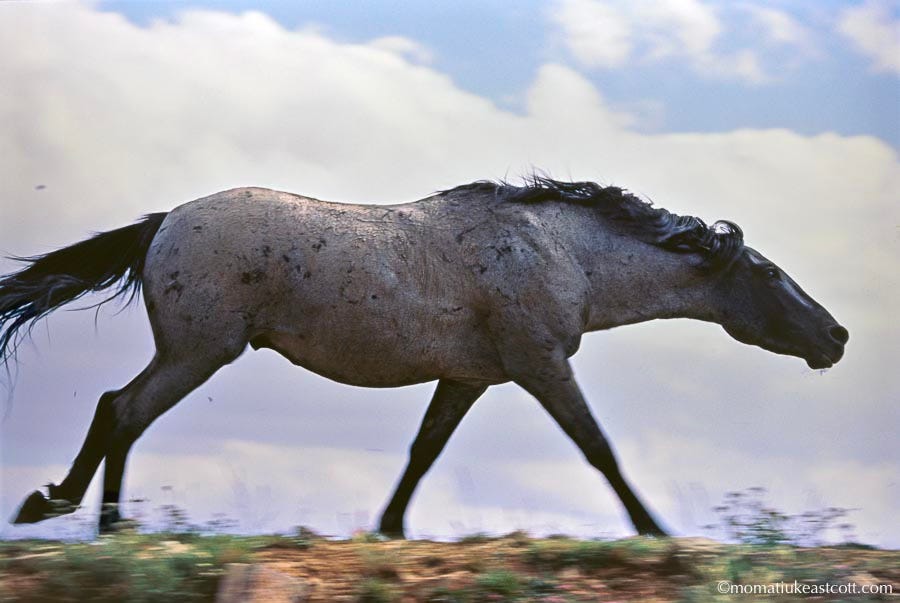
A loud rapport of breaking branches sends me spinning as a great muscular shape crashes through the dark spruce thicket straight toward me. In panic, my thoughts crowd each other: a bear, or a cougar? The dappled moonlight reveals the large head and bulging eyes of a wild stallion, who slides to a halt inches from my body. Ready to defend his mares hidden in the forest, he inhales my scent, blows out noisily and I realize that what saves me from being trampled and killed is his sudden recognition of my smell. He and I know each other.
For nearly six years my husband John and I have been following free-roaming mustangs of the American West, and this young stallion, one of about 140 horses living on the Pryor Mountain Wild Horse Range on the Montana-Wyoming border, came of age on our watch. Two summers ago, I used to trail behind his first harem of mares and foals, slouching my shoulders and bending my knees not to appear threatening, for in spite of our difference in size I was a nature-designated predator, as dangerous as the cougars who recently returned to the Pryors and relished horse meat. The stallion and his fellow ungulates were prey and they knew it, so any time I moved too abruptly the band galloped away, leaving me to swallow the dust.
At first I kept my distance, singing sweet tunes to make my presence known. Later I began to crawl close till I could nap near the resting band but the proximity forced me to be even more cautious. To remove a blade of grass between my lens and the horses I had to sneak my arm slowly through the clumps of alpine flowers, freezing whenever one of the animals regarded me with an alert, liquid eye, then gradually bend the grass with my fingertips rather than pull it out.
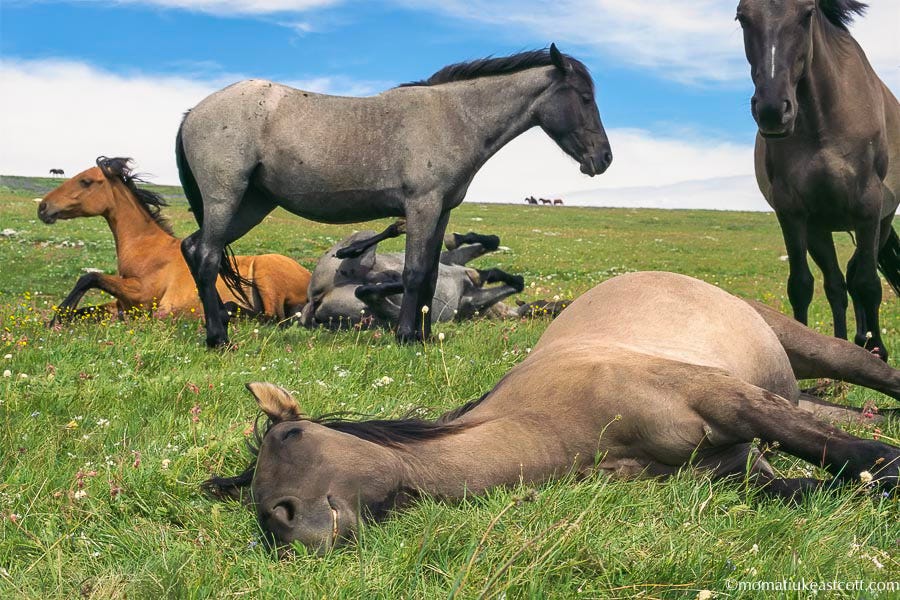
It was a motley group: an old mare with a pencil-shaped blaze and mouse-colored body whose broken hip grew together crooked, her yearling colt, another youngster whose mother was missing and a couple of fillies with primitive zebra stripes markings on their hind legs, typical of many horses in the Pryors. Nervous and unsure of his new status, the young stud seldom slept deeply but after each nap he would elegantly arch his neck and stretch the hind leg to align every little tendon and muscle down to the gracefully pointing hoof. I called him ‘Baryshnikov.’
In time, we developed a useful body code. If I came too close - and his radius of safety zone changed daily, depending on wind direction, dangers he sensed and other factors I could not decipher - he would raise his head to appear larger and move toward me with bold steps and obliquely implied menace. I would step back, and if he was satisfied he would turn away; if not, he would stare till I retreated or sat down to appear agreeably small. At other times, he would look squarely in my eyes, as if asking: “What do you want?” then shake his head and walk away. He seemed curious and intelligent, and I spent so much time following him that my husband joked he lost his wife to a wild stud. In a way, he was right.
Yet Baryshnikov only endured my presence, displaying patience typical of wild stallions confronting many difficult aspects of their lives. Once they acquire mares, an act which ends their carefree bachelor days, mustang studs become one-horse commando troops. Tense and covered with scars of fierce battles, forever scanning the horizon and analyzing strange odors, they graze and sleep only when all seems safe. They discipline youngsters, tenderly groom their mares and protect their families from danger.
Popular myths depict harem stallions as testosterone-driven beasts with huge sexual appetites and no duties, but most of the year the studs must act as sentries, bodyguards and sensitive suitors. The breeding period is brief: mares come into their first estrus a week after giving birth and, once impregnated, are not sexually receptive for the duration of their 11-month gestation.
But in the social structure of wild horses even the strongest and most alert stallion is easily replaced. He may break his leg, age, sicken or otherwise lose his tenuous right to rule. He is a shooting star, while a mare’s position at the core of a family band remains unchanged even though her status may: with time, she can become a lead mare who travels at the head of the band and finds the safest path, while a stallion protects the rear.
Less competent males follow their impulses heedlessly and lose their harems. They are, by mustang standards, poor providers. We saw a young stud painstakingly amassing a band of females and then, unable to resist the urge to chase every bachelor on the mountain, having them stolen by a puny challenger while he was gone.
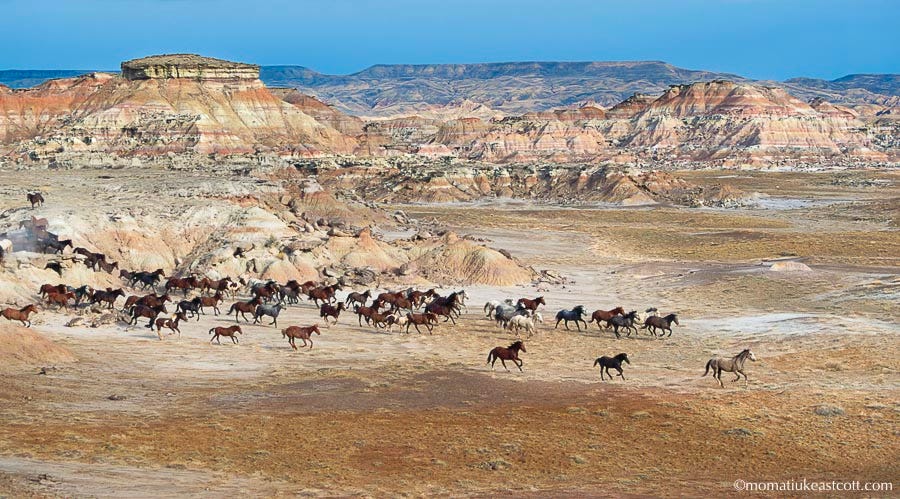
Seeking new bands, we roam the high plateau of Wyoming’s Red Desert encircled by two arms of the Continental Divide, where brief and hot summers with daytime temperatures around 100°F give way to the blizzards and gales of winter, when the mercury can plummet to -45°F. The windswept buttes, eroded arroyos and dusky canyons unfold enormous under the vast dome of the sky.
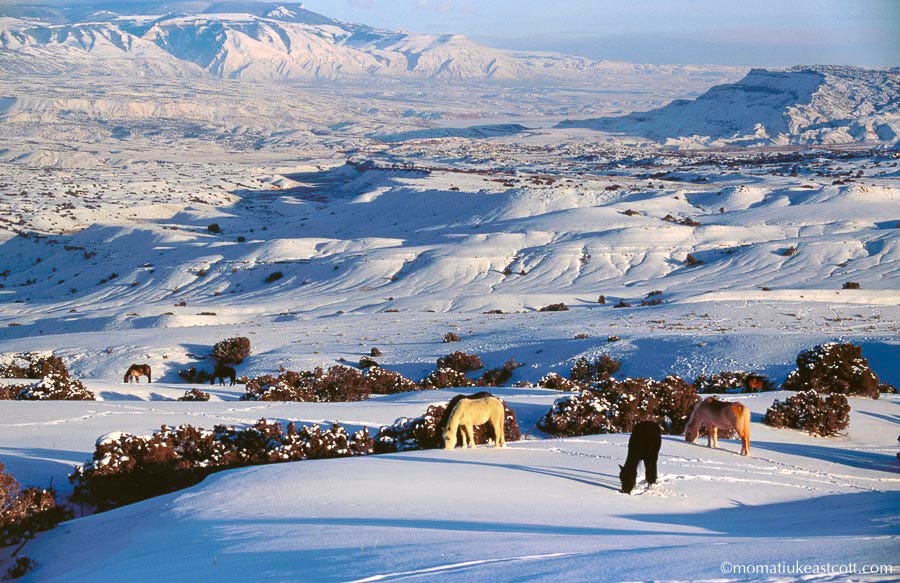
Mustangs are not territorial and roam their home range in herds broken into separate family units but unlike in the Pryors, the Red Desert bands are very large and often contain several stallions, with one stud dominating the others and claiming mating privileges to himself. The horses we see spook easily. I keep on singing and creeping close but one winter day an enraged stud charges me, and I lose my nerve. I turn and run, then catch my foot and fall, painfully ramming my face in a frozen drift and burying my camera in the snow. The stallion snorts and lets me be: crumpled on the ground I am no longer dangerous.
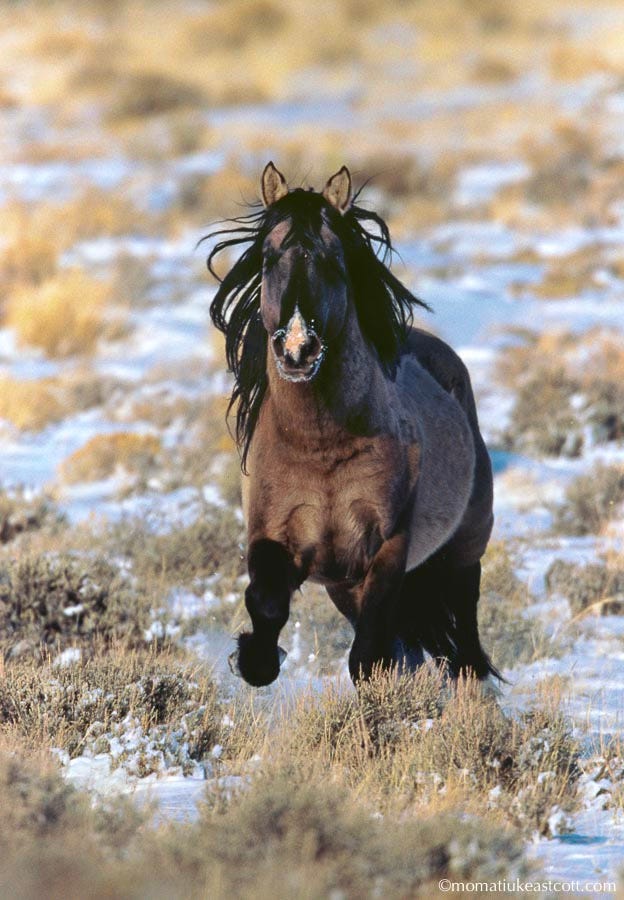
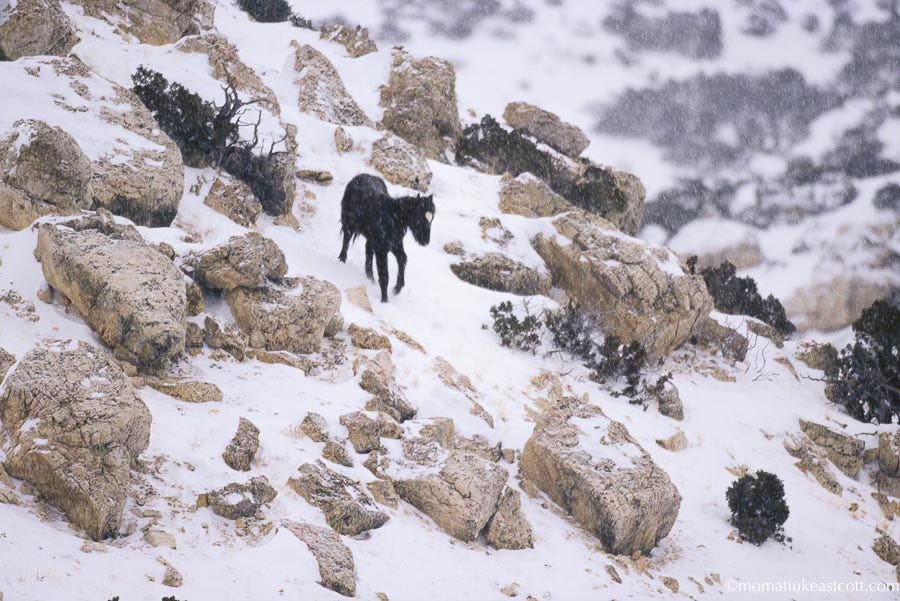
Winters are hard: they are true bottlenecks of all lives in the high desert, and wild horses are no exception. The Pryor bands descend to lower elevations and dig in heavy snow cover in search of winter grasses, forbs and shrubs -- anything they can digest. Not only their winter diet is surprisingly varied but their ability to extract maximum nutrition from their winter range allows them to maintain good condition and grow thick winter coats.
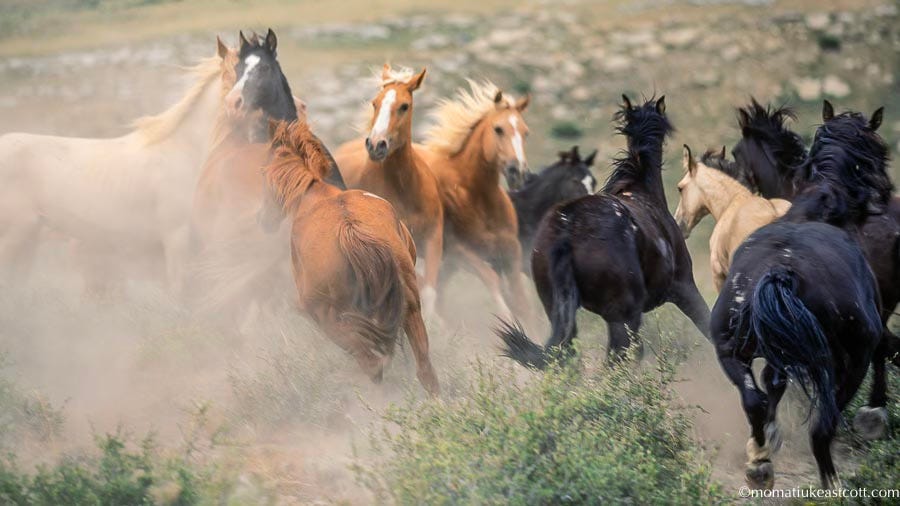
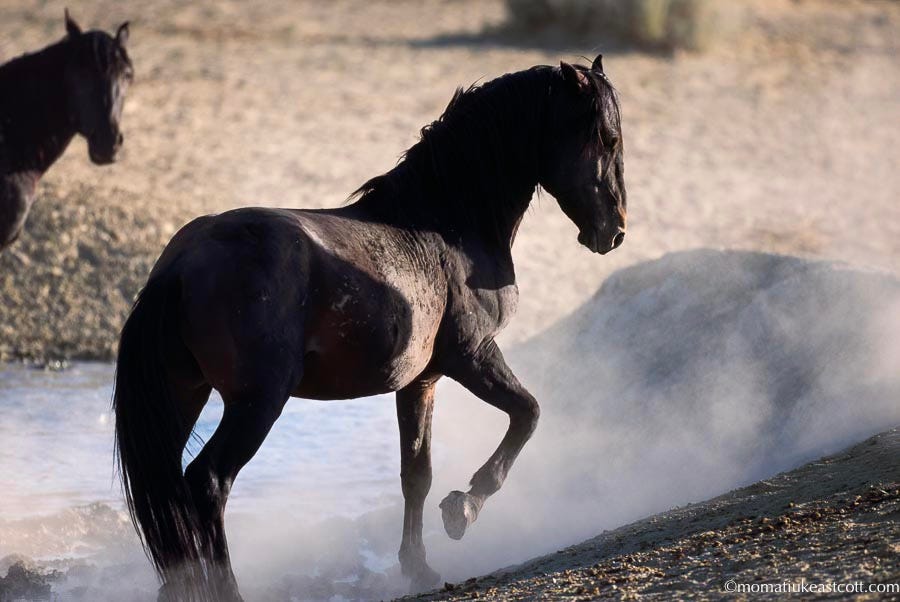
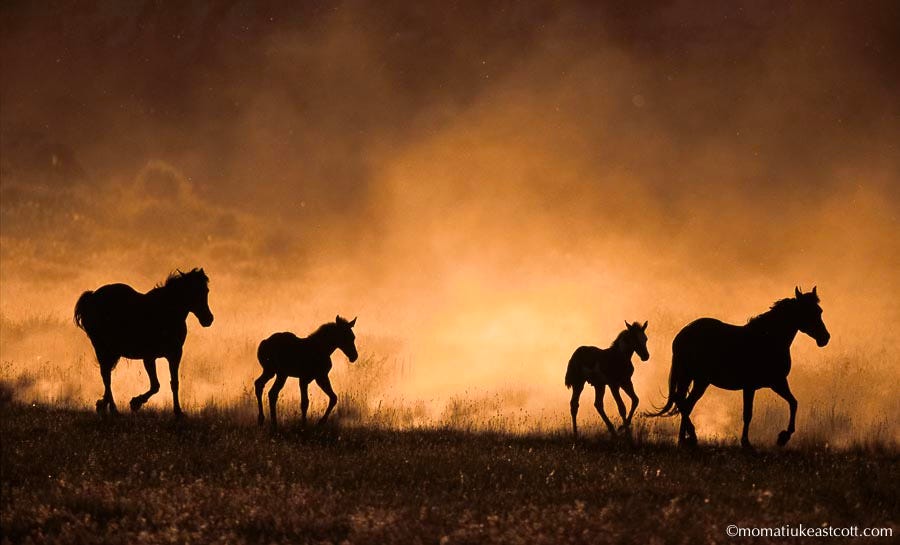
In summer, after the heat drains seasonal creeks, we spend nights near shrinking water holes, watching for rattlesnakes and huddling for warmth as soon as the sun dips. In winter, horses can satisfy thirst by eating snow but once it melts, they must find water or die. At dawn we see a puff of dust exploding over the ridge, followed by the thunder of approaching hooves. Bachelor bands and harems led by timid studs line up to await their turn, not unlike passenger planes on a busy runway. Dominant stallions step forward first, prancing and posturing to intimidate other males and reinforce their own high rank, then check around for the imaginary sabre-fanged predators wild horses associate with their drinking places. After slurping their fill, the studs roll in mud and shake like dogs to relive the itch of insect bites.
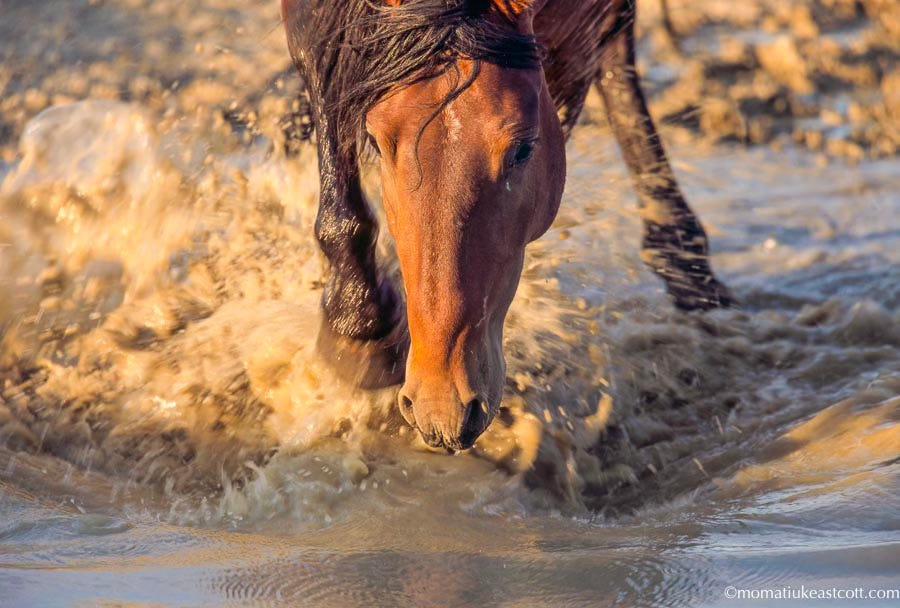
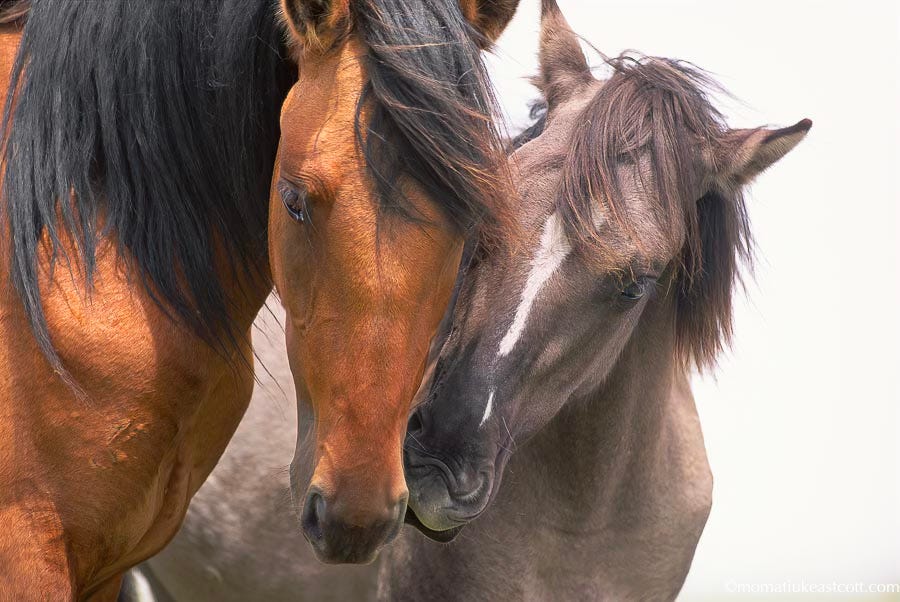
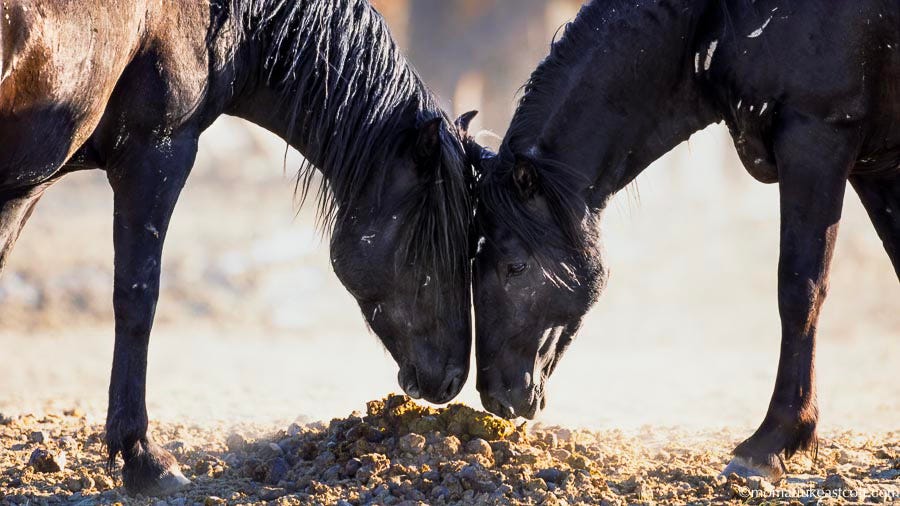
Their mares drink next. They touch shoulders and bring their soft muzzles together to share the sweetest gulpfuls, while newborn foals just watch: they get their moisture from mothers’ rich milk. We learn that once our scent becomes familiar, some mustangs will let us approach them again even after months of absence, providing we reintroduce ourselves by leaving our smell on the ground and urinating on “stallion piles,” monstrously large deposits of communal dung which stallions frequent, dumping fresh steaming loads on top and inspecting the results with intense curiosity.
It is not generally known that the mustangs’ ancestors, predecessors of the modern Equus caballus, evolved in North America during the Eocene Period some 60 million years ago. Fossils reveal the tiny “Dawn Horse” no larger than a cat. Its evolutionary descendants grew in size, lost their toes in favor of one monolithic hoof to ensure great speed, and developed large teeth driven by powerful chewing muscles. Some paleontologists estimate that during the Pleistocene these early ungulates of the genus Equus became more numerous than the bison.
The true caballoid horse emerged about 2 million years ago, migrated back and forth across the Bering land bridge, then vanished mysteriously from the New World perhaps 10,000 years ago, not unlike the camel and the mammoth. Phenomenally successful in their long process of biological adaptation, the North American horses may have been eradicated by Paleolithic man who relished their meat.
In the early 1500s, Spanish conquistadors reintroduced horses to their native land, completing their dramatic journey around the world. Some of these sturdy Barb steeds managed to escape and form the early nucleus of the wild herds roaming the American West; Spanish blood is still apparent in many Pryor horses and a few other isolated herds.
To the Plains Indians, the horse gave mobility and power, transforming their economy: they no longer had to ambush buffalo on foot or use dogs to carry their loads. Called the medicine dog, the horse was the new measure of prosperity and a tool of warfare. Soon horses galloping across open spaces became the symbol of the wild West and the term ‘mustang’ synonymous with a small hardy horse of the American plains. The horse culture of the newly settled West increased the nation’s appetite for new mounts. Pursued by mustangers, the wild herds provided the U.S. cavalry and cowboys with countless animals. Hundreds of thousands of wild horses were later slaughtered for pet food.
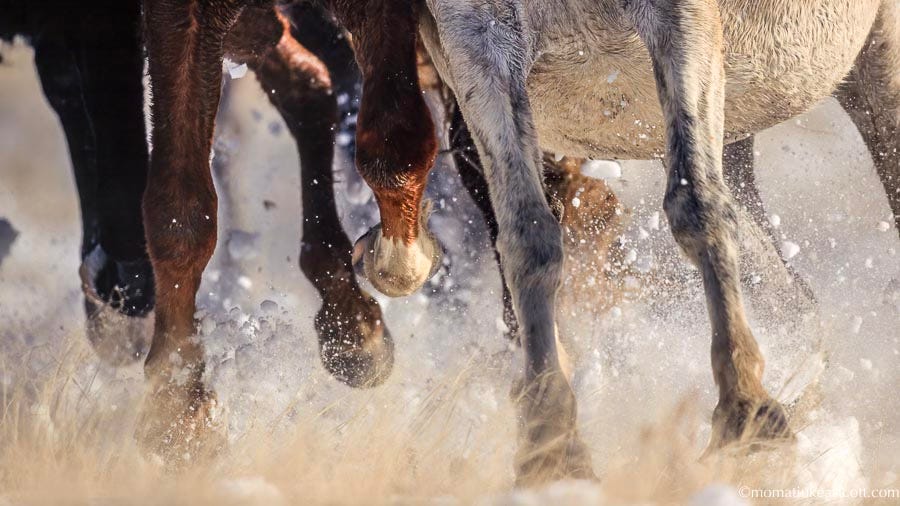
A few old mustangers still survive to tell the tale. Robert Holbrook, who lives in Wyoming, grew up nomadic. He was bouncing on a rolled up coat in front of his mother’s saddle before he could walk, while she lassoed wild horses with one hand and held him with another. He remembers that during the Depression many cowboys resorted to mustanging to survive. Holbrook learned to dig hoof-sized holes in the middle of a horse trail, surrounding them with a rope loop triggered by a willow spring. Caught by a leg, the frightened mustang would jump straight up with his back arched like a cat, but if he was running too fast his hip bone would snap. Another trick involved stringing toilet paper along the walls of a canyon frequented by wild horses and building a crude corral trap where the strands converged.
“The Indians used all the old clothes they could find instead of paper," Holbrook says. “As long as the flapping movement funneled the horses into the trap, it worked. Boy, they were so scared they would hit that corral going like an express train, and often pile up at the far end, tearing it down. My granddad once roped a palomino mare as she was trying to get out, jumping higher than you would ever believe a horse could go, and he broke her neck. You just couldn’t help it. Sometimes we watched a band for a few days, and after the horses filled real heavy with water and couldn’t travel fast, we would chase them and rope some that way.”
Once subdued, many horses were taken hundreds of miles away to a slaughter house. Denied water and feed, countless animals died on the way. The methods used in captures were so inhumane that a widespread grassroots movement to preserve mustangs as a symbol of the historic spirit of the West eventually stopped the killing.
By 1971, when the Free Roaming Wild Horse and Burro Act designed to protect the remaining mustangs passed the U.S. Congress without a single dissenting vote, the number of wild horses had dropped from more than a million in 1925 to a mere 17,000. Today about 73,000 mustangs live on public lands in nine Western states, an area larger than France. They are found - if they can be found at all - in remote and inhospitable pockets of wilderness, and tracking them down requires patience, a sturdy 4WD vehicle and a good pair of legs.
Since mustang herds grow about 20% percent a year, federal Bureau of Land Management organizes seasonal roundups to keep the numbers down, gathering horses with helicopters and crews of wranglers on horseback. Over the years, around a quarter of a million mustangs have been adopted by the public, a policy questioned by animal rights groups.
No conservation battle is ever permanently won. In the years since the act of Congress became the law, much effort has been made to undermine it. The free roaming horses, although they live in the least hospitable regions from Mexico to the Canadian border, are considered vermin by many Western ranchers who graze their livestock on public lands for a nominal fee and want no competition for feed. Other opponents argue that as non-game animals, the horses do not offer tangible benefits to hunters, or anyone else. Still others think they are simply ranch horses which escaped, inbred and became sickly and ugly, as well as useless.
Yet for every opponent there are ranks of those who want to save the mustangs, from the Tillet ranching family who canceled their grazing leases to help create the Pryor Wild Horse Range, to many environment protection organizations, tireless activists and private citizens.
The sentiment runs deep and often assumes an unexpected angle. When I ask a BLM wrangler who every week ropes the surplus mustangs destined for adoption, if he ever ate horse meat or would like to try, Todd Nunn replies: “Never. They are just too pretty. Now, a cow or a pig, they’re ugly. You are doing them a favor....”
Recently the struggle to eliminate the remaining mustangs has intensified, including drive-by shootings of the horses and harassment of officers enforcing the law. Greed also plays a role: some officials involved in the adoption program are under investigation for diverting thousands of animals to slaughter houses, where they can fetch up to $700.
Tom Pogacnik, the National Horse and Burro Program director responsible for the policies concerning mustangs and their uncertain future, works in Reno, Nevada, a desert town where in the dead of winter starving mustangs come to graze on suburban lawns. He points out that no one really knows how to manage wild horses and help them coexist with people, but believes that what we learn from mustangs about nutrition and behavior can be useful to make a domestic horse better. He knows about threats, the shootings, the hatred.
Pogacnik also knows about love. “When you see the range with plenty of grass and horses in good health with big fat foals at their side, everything fits,” he says. “They are sweet, smart animals, and not because they were trained to be that way. People really want to know mustangs are still running free out there, even though they may never see one.”
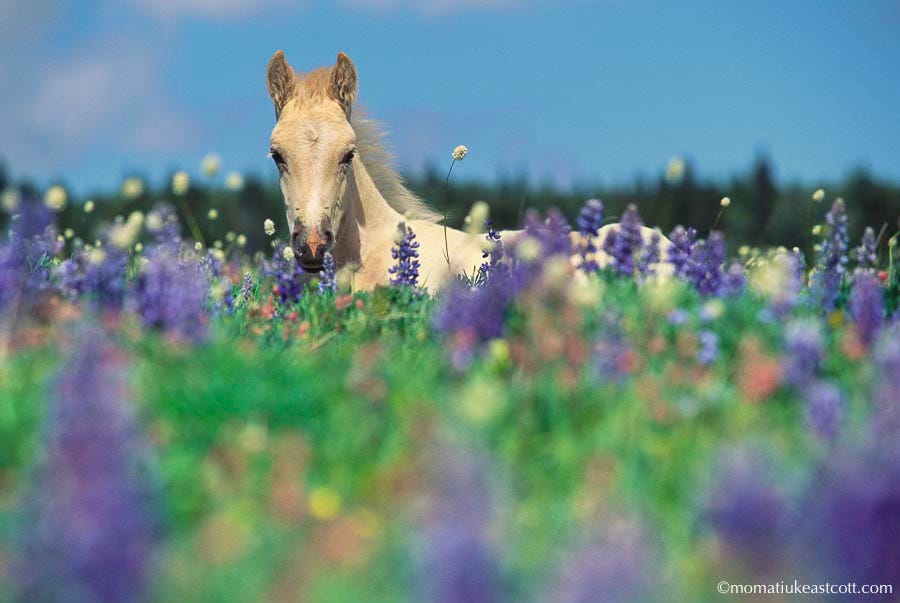
Mustangs - spirited, untamed animals - occupy a special place in our collective psyche. They symbolize much of what we lost: open spaces, self-sufficiency and a measure of freedom. They offer us a lesson in social organization and animal psychology, unhampered by breeders' needs for desired conformation, color and behavior.
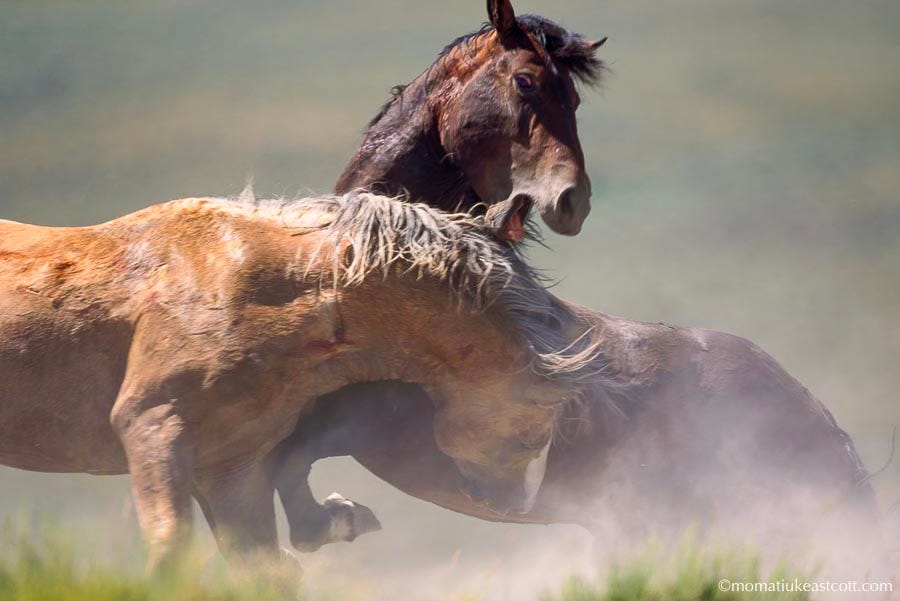
In their remote habitat they undergo the laws of natural selection, form families and friendships, fight, play, nurture and care for each other. Their hair grows long in winter to protect them; their bones are dense and strong; their hooves need no trimming; they live short and intense lives and die at times of drought, famine, searing heat and teeth-cracking cold. Mustangs can teach us what we do not know, for their domesticated kin have lost many of their natural traits. Their presence helps maintain much needed biodiversity, and their sight gives us the thrill of watching big, spirited animals who belong to each other and to the land.
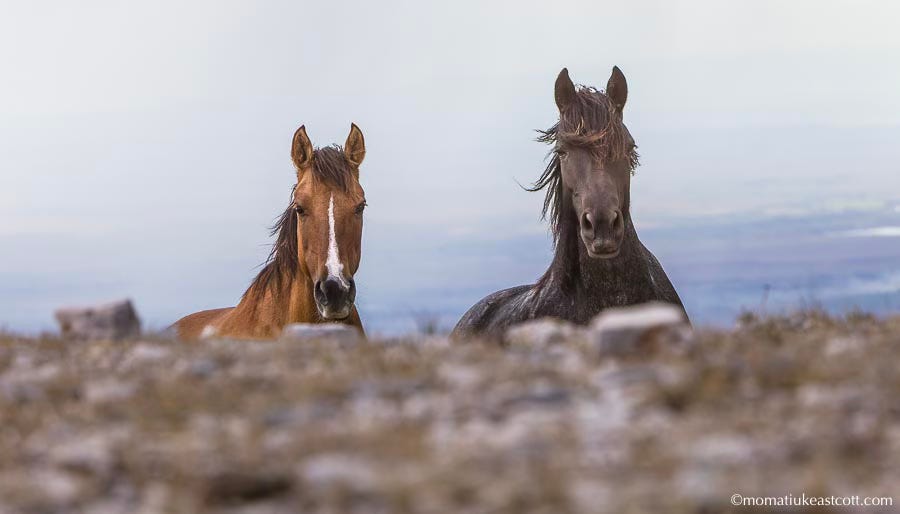
One summer day, we return to Pryor Mountain, rising like a huge whale of rocks from the Bighorn River basin. Several bands are loafing inside a bowl-shaped meadow on the summit. All is peace, and the foals are indeed fat and happy. I notice that Raven, the dominant stallion on the range, is herding his band toward the water over the hill but his lead mare has been accidentally left behind. She is asleep, flanked by her palomino yearling and a newborn colt. I am thinking: “Horses can’t count” and want to wake her but she soon jerks her head up and understands her predicament only too well: she is alone and unprotected.
Surrounded by other bands, the mare trots in small circles and her distress alerts all nearby harem studs who are fired by the hormonal surge of the breeding season. One by one, they lower their heads and “snake” their necks, their ears pinned and eyes bulging, trying to herd her toward their bands, but she is frightened and keeps turning away.
There is Baryshnikov, too, older, more aggressive. He attempts to mount her repeatedly against her will, and she screams a high-pitched scream, kicking him viciously till he retreats to his band. Her foals run around, terrified. I remember a scientific account of such equine rapes, seldom observed, and their possible explanation: a stallion who tries to intercept a pregnant female may force himself on her, causing her to miscarry so he could pass on his DNA.
The mare wheels about and gets trapped between bachelor males. She screams again and suddenly a muscular black stud appears on the hill above, running like a wind. One white sock... another... it is Raven! I feel relief as I watch him dispatch four bachelors, one after another, falling only once to protect his armpit vein which one stallion tries to sever with his teeth. When he reaches his mare, she unexpectedly gives him a healthy wallop with her hooves, as if saying: “Where were you when I needed you?” Then they rest, breathing heavily, and soon trot back to their band with their tired foals, peaceful again.
©Yva Momatiuk 2026
An informative and beautiful story about mustangs, their nature and the author who has a personal connection to one of the stallions. Thank you, Yva, for an escape to the open range mountains of Wyoming.